

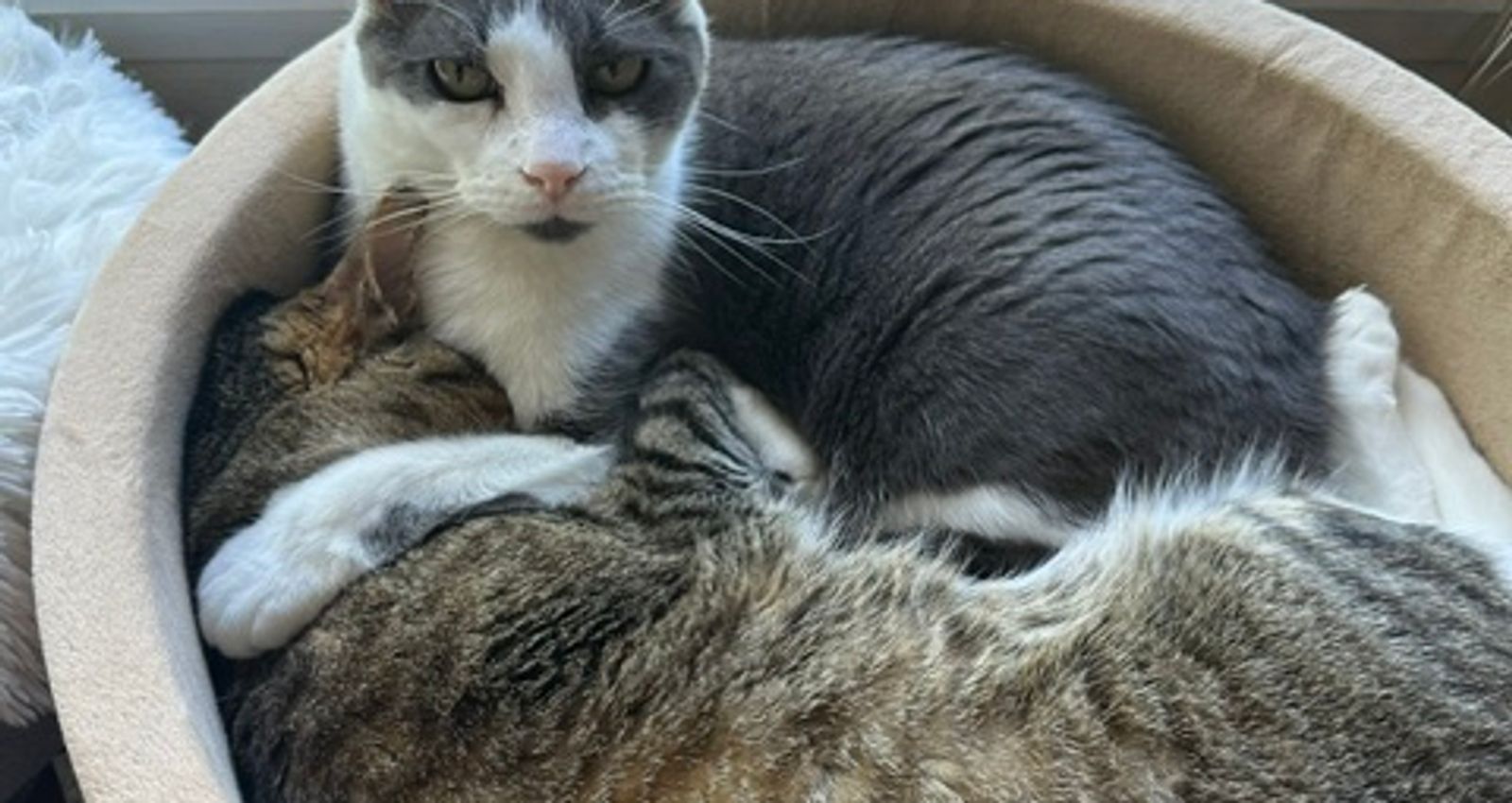
Cats have social relationships, but the familiar idea of a rigid, linear pecking order usually does not describe them well. One cat is not necessarily the permanent "alpha" in every room and around every resource.
Free-ranging cats can form social groups when resources—especially food—are concentrated. These groups often center on related females and their offspring. Within them, cats form preferred relationships: some groom, rub, rest, or raise kittens together, while others avoid one another. Household cats can also form one social group, several smaller groups, or no close cat-to-cat bonds at all.
Relationships depend on context
A cat who reaches the food first may yield a resting place later. Another may control a narrow hallway because the location favors blocking, not because that cat outranks everyone. Age, health, familiarity, motivation, escape routes, and resource placement can all change an interaction.
Calling one cat dominant can hide the more useful question: does every cat have safe access to what they need? Subtle tension may appear as staring, blocking, stalking, chasing, avoiding rooms, eating only when another cat leaves, or waiting to use the litter box.
Design for choice, not rank
Rather than asking cats to "work it out," provide:
- Multiple, separated feeding and water stations
- Litter boxes in different locations
- Several elevated and concealed resting places
- More than one route through important areas
- Individual play and social time
- Visual barriers that reduce prolonged staring
Do not force cats to share beds, bowls, or close quarters because they appear friendly sometimes. Affiliative cats may share voluntarily; choice is what matters.
If conflict suddenly develops, schedule veterinary exams because pain and illness can change social behavior. A qualified behavior professional can help map the household's relationships and identify bottlenecks.
Cats are socially complex, but "Who is the boss?" is rarely the most accurate or helpful way to understand them. Focus on relationships, context, and access.
Are cats pack animals like dogs? Pack animal refers to how an animal hunts in the wild. Dogs hunt in packs and therefore create social structures in those packs. Cats are solo hunters so they are not pack animals though that does not mean they dislike other cats. Cats can be incredibly social creatures and greatly enjoy living with other cats.


